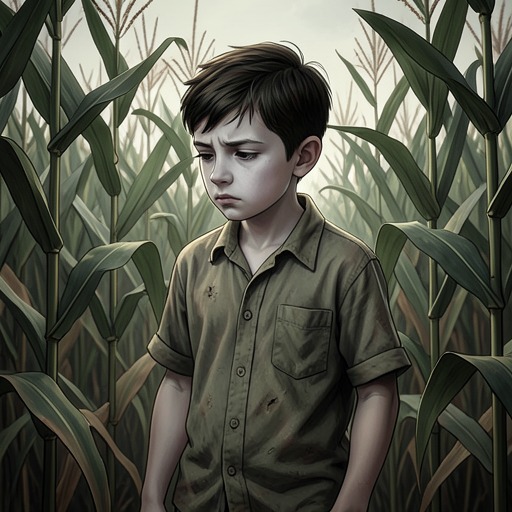
David
Children of the CornDavid’s death before the main events in Gatlin is the precedent that shapes the town’s sacrificial order: at nineteen, he entered the corn on his birthday, and his taking by the corn made Isaac the Seer. His remembered fate links the town’s eerie present to a ritual already in motion a year earlier.
Identity and Background
David was one of the older brothers in Gatlin’s child-led religious community. He was nineteen when he walked into the corn at dusk on his birthday. The account gives no further biography, but fixes his place in the community through that threshold: he was old enough to enter the corn under its sacrificial rule, and his disappearance became the defining event behind Isaac’s role.
The Town and Its Cornfields
The road into Gatlin first presents an ordinary rural landscape: farmhouses and outbuildings, chickens in a yard, advertisements faded on barn roofs, and a café beside a Conoco gas island. Yet the town’s familiar signs already seem out of time. Its entrance sign advertises a population of 5,431, while the nearby 76 station lists regular gasoline at 35.9 cents and high-test at 38.9. Vicky recognizes that the prices are at least four years out of date; Burt admits it.
The town’s quiet deepens the unease. Dusty, diseased elms shade the lumberyard and streets, and a mongrel dog lies down in the road. At the storefronts, Burt is struck by the silence and by a fertilizer smell with a sickly-sweet undertone that recalls death to him from his experience as a medical orderly in Vietnam. The town’s landscape looks neglected, but its corn is unnaturally immaculate: every leaf and stalk is perfect, without blight, insect damage, or even weeds. That impossible order gives the fields a force quite different from the ordinary farms along the road.
Death and the Seer
A year before the scene in which Isaac speaks, David walked into the corn as dusk settled over the summer rows. He was nineteen, and the narration presents his entry as the moment the corn took him. The spare account makes his birthday, age, and the time of day carry the weight of a rite: a personal threshold coincides with his passage into the fields.
David’s death also supplies the background to Isaac’s authority. Isaac is only nine, but has been the Seer since the corn took David. During a later gathering, he says that a dream showed him the Lord as a shadow walking behind the rows, speaking in words once used to the older brothers. The children, including Malachi, listen with dread and wonder as Isaac reports that the Lord is displeased with the present sacrifice. David’s absence therefore persists not merely as a loss but as the event that precedes Isaac’s prophetic position and lends weight to his warning.
Narrative Significance
David is known through recollection rather than through a sustained appearance in the story. That limited presence is consequential: the reader learns his fate at the same time the narrative explains why a child has become the community’s Seer. The sequence makes the corn’s taking of David a point of origin for the authority and sacrificial history governing Gatlin.
The town’s decayed public signs and timeworn prices contrast with the corn’s flawless growth. Against that contrast, David’s passage into the field reads as more than a disappearance into farmland: the corn is presented as a power capable of taking people and shaping the community’s religious life. His story establishes the history behind the children’s present ritual, while Isaac’s dream suggests that even this order can be judged by the power it serves.